A new China-Europe Arctic Express service is set to launch this August, offering importers an alternative shipping option that bridges the gap between traditional ocean freight and air freight. The service has been developed to provide faster transit times, reduced sailing distances and lower carbon emissions, creating a compelling proposition for businesses moving time-sensitive and high-value cargo between Asia and Europe.
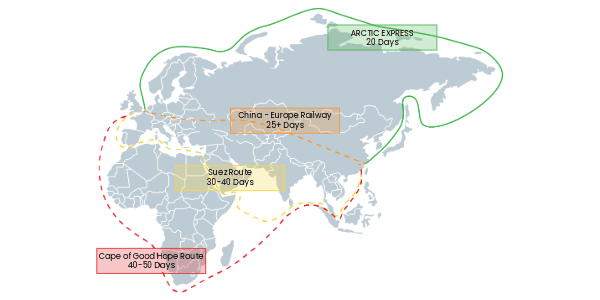
At the heart of the service is a reported transit time of around 20 days from China to Felixstowe. By comparison, traditional routings via the Suez Canal typically take 30-40 days, while voyages routed around the Cape of Good Hope can take 40-50 days. The Arctic route also reduces sailing distance from approximately 11,000 nautical miles via Suez to around 7,800 nautical miles, helping to shorten overall journey times.
The concept is straightforward: shorter transit, faster delivery and lower emissions. Due to the reduced voyage length, the service operator reports that carbon emissions could be reduced by up to 50% compared with conventional routings, making the service particularly attractive for organisations with sustainability and ESG objectives.
The route links major Chinese ports including Dalian, Qingdao, Shanghai, Fuzhou, Nansha and Ningbo with key European gateways such as Felixstowe, Rotterdam, Wilhelmshaven and Gdynia. Weekly scheduled sailings are expected to provide consistency and reliability for supply chains requiring regular departures and predictable transit schedules.
Who Could Benefit?
While the service has broad cargo acceptance, it’s expected to be particularly well suited to businesses shipping goods where delivery speed is important but air freight costs are difficult to justify. According to the operator, the service can accommodate general cargo, hazardous cargo including batteries, high-value shipments and cross-trade movements from multiple Asian origins.
Potential applications include:
- Batteries and new energy products
- E-commerce shipments
- High-value goods
- Urgent replenishment stock
- Time-sensitive supply chains requiring faster inventory turnover
For businesses facing pressure to reduce lead times, improve stock availability or minimise inventory holding costs, the service could offer an alternative between premium-priced air freight and slower conventional sea freight options. The operator also highlights potential benefits such as faster stock replenishment, improved cash flow and reduced inventory costs.
A New Option for Importers
Supply chains have become increasingly focused on resilience, flexibility and sustainability. As a result, opportunities that offer meaningful improvements in transit time without the cost of air freight are attracting significant interest across a range of sectors.
The China-Europe Arctic Express represents another development in the evolving freight market, providing importers with an additional routing option that could prove particularly valuable for high-value and time-critical cargo movements. As with any new service, factors such as capacity, demand and long-term operational performance will ultimately determine its place in the market, but the reported combination of speed, reliability and reduced emissions is likely to attract attention from shippers across Europe.
Need More Information?
If you’d like to explore whether the China-Europe Arctic Express could support your supply chain, contact the Uniexpress team for the latest sailing schedules, capacity availability and freight quotations.
Shorter transit. Faster delivery. Lower emissions. That’s the promise behind this new Arctic corridor – and one many importers will be watching closely in the months ahead.